testwork
| Testwork Programs That Deliver Multiple Data Sets
Mining projects are applying the age-old notion of "check your work" against comminution circuit design, mill power requirement estimates and mill throughput estimates. The best way to test the results of one comminution modelling system is to replicate the calculation in a different modelling system. Unfortunately, the most common comminution modelling systems require largely incompatible test programs to provide input parameters. This paper presents some example protocols for sample collection and preparation from drillcore that simultaneously returns comminution datasets suitable for a Bond Work Index based method, an Axb dataset, and a set of SPI results. By carefully collecting data for all three methods, high quality geometallurgical dataset can be created.
(Presented at Procemin 2008, Santiago, Chile)
[↑ read less ↑] [download]
Mining projects are applying the age-old notion of "check your work" against comminution circuit design, mill ...[↓ read more ↓] [download]
| Alex Doll & Derek Barratt | |
testwork
| Effect of Sample Dimensions on Comminution Testwork
Comminution tests on a particular project have displayed completely different breakage characteristics relative to a database, depending upon which test procedure was performed. Some of these differences are attributed to the dimensions of the sample that is presented to a test, e.g., a Bond crushing test compared to a ball mill test, while other differences can be attributed to a hardness profile that is inherent in a particular size class compared to another coarser or finer size class, e.g., fracture density and mineral filling and/or grain size. Ore types can respond with a characteristic hardness profile by size which may not be identified if only one sampling and testwork regime is used.
(Presented at Procemin 2009, Santiago, Chile)
[↑ read less ↑] [download]
Comminution tests on a particular project have displayed completely different breakage characteristics relativ...[↓ read more ↓] [download]
| Alex Doll & Derek Barratt | |
testwork
| Comparison of UCS to Bond Work Indices
Unconfined Compressive Strength (UCS) is a commonly used rockmass strength measurement used by rock mechanics practitioners. This paper examines potential relationships between UCS and Bond Work Index values (crushing, rod mill and ball mill). Data from 11 mines located around the world is analysed for correlations between UCS and various Wi values.
[↑ read less ↑] [download]
Unconfined Compressive Strength (UCS) is a commonly used rockmass strength measurement used by rock mechanics ...[↓ read more ↓] [download]
| Alex Doll, Derek Barratt & Ken Wood | |
testwork
| Effect of core diameter on the Bond impact crushing work index test
The Bond low energy impact (crushing) work index test is specified to be performed on rock specimens between 50 mm and 75 mm in effective diameter. NQ-diameter drill core, frequently used in mineral exploration programs does not meet that specification, it being 45 mm diameter or less.
This paper reports the effect of performing the impact test on contiguous sections of HQ diameter and NQ diameter core, exploring the hypothesis that the contiguous intervals give equivalent results in spite of the core diameter difference.
[↑ read less ↑] [download]
The Bond low energy impact (crushing) work index test is specified to be performed on rock specimens between 5...[↓ read more ↓] [download]
| Alex Doll, Derek Barratt & Bob Phillips | |
testwork
| Testwork template spreadsheet
Blank spreadsheet that is pre-populated with the field names needed to import laboratory test results into the SAGMILLING.COM circuit model testwork database (subscription required).
Enter your test results, one per row, arranged into the columns indicated.
To import into your testwork database, copy the block of cells starting with the top row down to the bottom of your data. Paste this block into the import field in the website "add testwork" page (do not worry if the text looks scrambled, the website can understand it).
[↑ read less ↑] [download]
Blank spreadsheet that is pre-populated with the field names needed to import laboratory test results into the...[↓ read more ↓] [download]
| Alex Doll | |
testwork
| Calculating DWi from a drop weight test result
The drop weight test is a common laboratory measurement used to determine the comminution characteristics of rock samples. A common metric derived from a drop weight test is a value "A×b". Another common metric that is derived from the SMC Test™ variant of a drop weight test is a "Drop Weight Index", abbreviated as DWi. This work looks at a public database of test results to determine a relationship for DWi as a function of A×b.
[↑ read less ↑] [download]
The drop weight test is a common laboratory measurement used to determine the comminution characteristics of r...[↓ read more ↓] [download]
| Alex Doll | |
testwork
| Commentary on the apparatus of the Bond rod mill work index
The Bond "Third Theory" of comminution was originally divided into three size classes reflecting the varieties of comminution equipment common during the time period when Bond (and his collaborators) were gathering the information to calibrate comminution models. The middle size class, represented by rod milling, is fitted to a tumbling test, referred to as the Bond rod mill work index (Wi RM , or RWi).
The apparatus used to determine this work index was described in 1943 by Bond & Maxson. Unfortunately, there are some laboratories that have deviated from the apparatus specified by Bond & Maxson and there are modern comminution models that are calibrated to this non-standard mill geometry. (document revised 2023-08-09)
[↑ read less ↑] [download]
The Bond "Third Theory" of comminution was originally divided into three size classes reflecting the varieties...[↓ read more ↓] [download]
| Alex Doll | |
testwork
| Database of public grindability testwork
Spreadsheet that accompanies the Procemin 2016 paper by Alex Doll. This spreadsheet contains a database of public grindability testwork for projects worldwide. The data is collected mostly from conference papers and NI 43-101 reports. The NI 43-101 data may not be used for commercial purposes (hence it is being given away); but it may be used for research purposes such as model calibrations and project benchmarking.
Last updated 2023-12-25.
[↑ read less ↑] [download]
Spreadsheet that accompanies the Procemin 2016 paper by Alex Doll. This spreadsheet contains a database of pu...[↓ read more ↓] [download]
| Alex Doll | |
testwork
| A public database of tumbling mill grindability measurements and their relationships
This work presents a public database of over 800 grindability measurements and a set of equations for converting between different grindability tests based on this database. Several laboratory grindability measurements commonly used in the mining industry; each is generally applicable to a particular grindability model and is incompatible with other models. Conversion between different test types is possible using a series of empirical relationships between those tests conducted at similar size classes.
The commonly used grindability tests included in the database are the Bond work indices for ball milling, rod milling and crushing; the drop weight test results A, b, A×b, DWi, Mia, Mic, Mih and ta; SAG grindability index, SGI or SPI™; and other values such as Mib and point load index.
Some examples of power-based model specific energy predictions will be compared to published mill surveys to observe how well the different models predict the specific energy of an industrial mill.
[↑ read less ↑] [download]
This work presents a public database of over 800 grindability measurements and a set of equations for converti...[↓ read more ↓] [download]
| Alex Doll | |
testwork
| Appendix- Conversions between grindability test results
Appendix to the Procemin 2017 paper.
Provides basis of conversion between different grindability metrics from laboratory test results. Gives equations to convert between:
- Morrell Mia and Bond WiRM (RWi), rod mill work index
- Morrell Mia and drop weight A×b (Eg. JK DWT Axb)
- drop weight Axb and SGI (SAG grindability index & SPI)
- SGI and drop weight Axb
- Bond WiRM (RWi) and drop weight Axb
- Bond WiRM (RWi) and SGI (or SPI)
- SGI and Bond rod mill work index (WiRM, RWi)
- Morrell Mic and drop weight Axb
All relationships were developed from the public testwork database published on SAGMILLING.COM (as of August 2017).
[↑ read less ↑] [download]
Appendix to the Procemin 2017 paper.
Provides basis of conversion between different grindability metrics fr...[↓ read more ↓] [download]
| Alex Doll | |
testwork
| Correction of Bond Ball Mill Work Index Test for Closing Mesh Sizes
It is commonly known that one must run the Bond ball mill work index test such you pick a closing mesh to give a P80 close to desired grind size. This is because work index frequently changes as a function of the product size in comminution. If target grind size during a project is changed, or if the test is run at the wrong product size, then it is necessarily to provide a correction.
The goal of this work is to create an equation to adjust a Bond ball mill work index from one P80 basis to another. The proposed model consists of two components, the variable coefficient that is determined from a specific work index determination and a fixed exponent determined by a calibration procedure. The model has the benefit of retaining the variability in hardness that is built into a database of work indexes, while using Hukki’s specific energy approach to adjust for P80.
The laboratory test work program was carried out on SAG belt cut and geo-unit samples of two BC copper-porphyry orebodies yielding an exponent of -0.56 across the range of typical ball mill particle size targets. For validation, the equation was run against African data by Levin (1989) revealing that the exponent changes for different ore types, but generally remains constant within an ore type. The results of this investigation confirm a sensible correlation between the existing theories that enable practitioners to calibrate and fit any work index data given the appropriate calibration exponent. Moreover, the experiments observed that Bond’s work index is less sensitive to variation in P80 than Morrell’s Mib index on the ores tested.
Paper was presented at Procemin·GEOMET 2018 in Santiago, Chile.
[↑ read less ↑] [download]
It is commonly known that one must run the Bond ball mill work index test such you pick a closing mesh to give...[↓ read more ↓] [download]
| Yardin Josefin, Alex Doll | |
testwork
| Designing an optimal comminution sampling program for geometallurgy
Paper presented at Procemin 2018.
Breakage characteristics of rocks will change as a function of size; this is one reason why there are so many different grindability metrics in use by the Industry. Designing a geometallurgical sampling program for grindability requires understanding a mine's ore breakage characteristics as a function of size so that the optimal mass and dimension of each sample is collected. This requires a multi-stage, iterative procedure where the initial programs collect a wider range of data that will, if possible, be reduced in later programs as the ore breakage is better understood. A procedure is offered where two initial programs are used to design a third "optimal" program.
The first program will use feed conveyor belt cuts, bulk samples collected from tunnels, or composites of large diameter drill core to "map" the rock breakage characteristics by size. This program requires some coarse samples; for example, whole HQ-diameter core.
The second program is a reduced variability sampling program that will ultimately become part of the overall geometallurgy data set interpolated into the mine model. Results of this initial variability program are examined to identify if any size classes are redundant and may be excluded from future sample collection.
The final program is the optimized variability sampling program that draws on the two earlier programs to use only the necessary laboratory testing at the smallest sample dimension. The combined results of the second and third programs become the overall geometallurgy data set.
This iterative procedure drives toward smaller sample dimensions and minimum laboratory testing, yielding the optimal program costs without sacrificing quality.
[↑ read less ↑] [download]
Paper presented at Procemin 2018.
Breakage characteristics of rocks will change as a function of size; this i...[↓ read more ↓] [download]
| Alex Doll | |
testwork
| Bond's Work Index: What it is and what it isn't
Bond's work index is one of the mostly widely used metrics of mineral grindability. In spite of its ubiquity, users are often not aware of the nuances of the work index family: what are its strengths and weaknesses. Moreover, the operating work index frequently gets confused for a specific energy (SEC) consumption in documents such as National Instrument (NI) 43-101 reports. Understanding where the work index fits into the family of power-based grinding metrics will help operators correctly apply the work index and avoid making mistakes.
Understanding your ore's variation of work index by size is particularly useful for SAG mill troubleshooting and production forecasting. Examples of the variation in work index at Centerra's Mount (Mt.) Milligan mine and the implications for mill operation and design will be discussed.
A revised definition of work index is offered that makes clear the distinction between specific energy consumption and work index.
[↑ read less ↑] [download]
Bond's work index is one of the mostly widely used metrics of mineral grindability. In spite of its ubiquity, ...[↓ read more ↓] [download]
| Alex Doll & Berge Simonian | |
testwork
| Reference Table for Drill Core-Grinding test compatibility
The table shows the minimum core length and diameter for a given test to be viable assuming a 2.75 t/m³ ore is used. This reference table has also been reviewed and was given feedback by Alex Doll of Alex G Doll consulting, Ltd.
Tests included are: Bond work indexes for ball milling, rod milling, & crushing, JK DWT, SAGDesign SMC, and SPI/SGI.
[↑ read less ↑] [download]
The table shows the minimum core length and diameter for a given test to be viable assuming a 2.75 t/m³ ore i...[↓ read more ↓] [download]
| Munashe Kurisa & Alex Doll | |
testwork
| Secrets of the Bond Ball Mill Grindability Test
The Bond ball mill grindability test is one of the most common metrics used in the mining industry for ore hardness measurements. The test is an important part of the Bond work index methodology for designing and measuring the efficiency of mineral grinding circuits. In spite of being called “Bond’s Law”, the work index equations are not a law of nature; but rather an empirically measured regression of a large data set collected by the Allis-Chalmers corporation in the period between 1930 and 1952. As a regression, it is valid within a specific “calibration space”, and great care is required when deviating the test procedures or observing results that are outside of that calibration space.
This paper is a collected summary of other works by the Authors that describe feed sizes, product sizes, quality control checks, and other information about interpreting the test and using its results. Examples of adjustments that are sometimes required when using the test are: changing the test product (P 80), and coping with a feed that is too fine to apply the “proper” feed preparation steps (such as is sometimes observed from HPGR or SAGDesign product testing). Related metrics, like the Morrell Mib value and Levin B value will be discussed, along with recommendations for their use on design projects.
The intended audience is any user laboratory work index test data.
[↑ read less ↑] [download]
The Bond ball mill grindability test is one of the most common metrics used in the mining industry for ore har...[↓ read more ↓] [download]
| Alex Doll, Vladimir Nikolić | |
static image
| Example test database plot
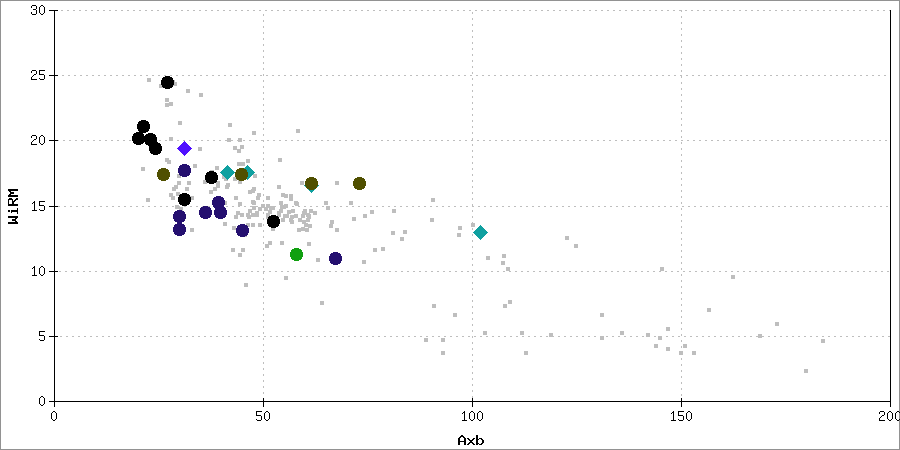
Example database chart for the Subscriber Tools page
[↑ read less ↑] [download]
Example database chart for the Subscriber Tools page...[download]
| sagmilling.com | |
static image
| Example circuit model
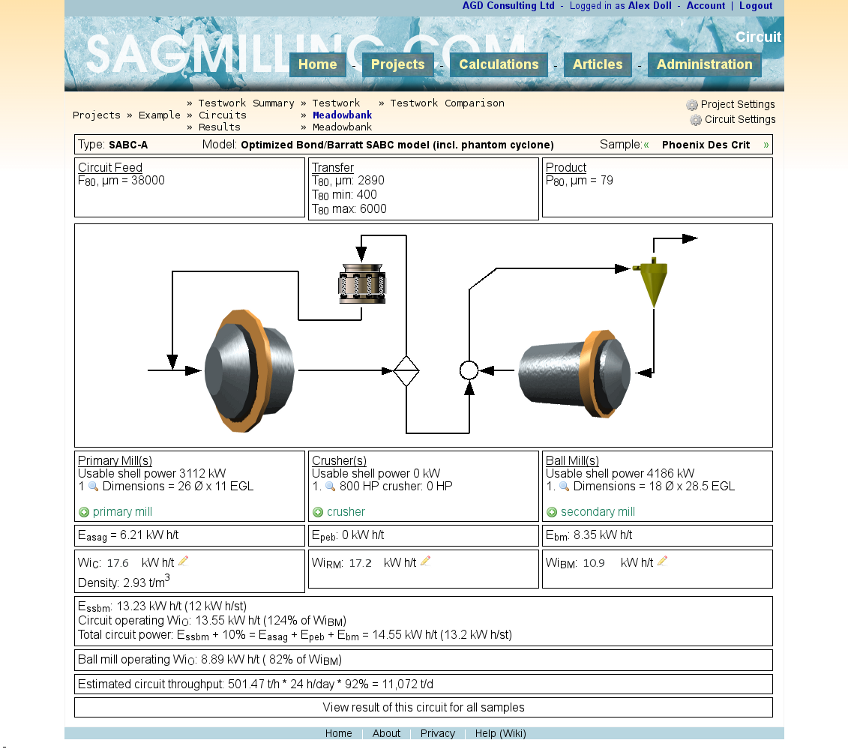
Example flowsheet page of a circuit model
[↑ read less ↑] [download]
Example flowsheet page of a circuit model...[download]
| sagmilling.com | |
modelling
| Rosin Rammler Regression Spreadsheet
Spreadsheet calculation that fits the Rosin Rammler equation to a set of particle size data consisting of an arbitrary quantity of results.
[↑ read less ↑] [download]
Spreadsheet calculation that fits the Rosin Rammler equation to a set of particle size data consisting of an a...[↓ read more ↓] [download]
| Alex Doll | |
modelling
| Fitting a Rosin Rammler equation to a 2-value data set
Calculation provides a quick way to estimate the Rosin Rammler equation parameters by using two data values to fit the two parameters, Dn and n
[↑ read less ↑] [download]
Calculation provides a quick way to estimate the Rosin Rammler equation parameters by using two data values to...[↓ read more ↓] [download]
| Alex Doll | |
modelling
| JK Ball Mill Model Notes
Review of the JKMRC Mineral Comminution Circuits textbook (Reference 1), and discussions with practitioners of the JKSimMet software have led to the following simplified description of the opera- tion of the JK method for modelling a ball mill. A scenario of scaling up a pilot plant test to a full sized circuit is assumed in this discussion.
[↑ read less ↑] [download]
Review of the JKMRC Mineral Comminution Circuits textbook (Reference 1), and discussions with practitioners of...[↓ read more ↓] [download]
| Alex Doll | |
modelling
| UBC MINE331 Lecture Notes
Memorandum describing the SAG mill & ball mill circuit sizing lecture delivered to the University of British Columbia mill design course (MINE331). Uses the "Bond Work Index" method developed by Barratt to size circuit power requirements from bench-scale testwork. (Revision 6, Nov 2015)
[↑ read less ↑] [download]
Memorandum describing the SAG mill & ball mill circuit sizing lecture delivered to the University of British C...[↓ read more ↓] [download]
| Alex Doll | |
modelling
| Liner Effective Height
Determines the effective mill inside diameter of a given set of "top hat" lifters for use in mill volume and critical speed calculations.
[↑ read less ↑] [download]
Determines the effective mill inside diameter of a given set of "top hat" lifters for use in mill volume and c...[↓ read more ↓] [download]
| Alex Doll | |
modelling
| Liner Effective Height
Determines the effective mill inside diameter of a given set of "top hat" lifters for use in mill volume and critical speed calculations.
[↑ read less ↑] [download]
Determines the effective mill inside diameter of a given set of "top hat" lifters for use in mill volume and c...[↓ read more ↓] [download]
| Alex Doll | |
modelling
| MillFillingCalc
Backup to the Mill Filling Calculation spreadsheets that describes the geometry and mathematics.
[↑ read less ↑] [download]
Backup to the Mill Filling Calculation spreadsheets that describes the geometry and mathematics....[download]
| Alex Doll | |
modelling
| A comparison of SAG mill power models
SAG Mill power draw models are used in mill design and grinding circuit modelling to predict how much power will be consumed by a particular mill geometry and operating configuration. This paper will compare SAG mill models by Morrell, Loveday (using "Power Numbers" published by Barratt) and Austin against several published mill surveys. The purpose of the comparison is to identify the "fitting factors" used by each model and to identify which mill configurations seem to better suit each model.
The importance of conducting surveys suited to model calibration will be highlighted because the review of literature shows that survey information important to modelling is often either missing or omitted.
A recommendation for the collection of data during a mill survey is presented, along with some assumptions used by the Author in the absence of certain data. The benefit to mining companies of publishing their survey data, and thereby allowing modellers to improve their model calibration, is discussed.
The comparison of models requires a discussion of the measurement of power in a mill drive system as the models use slightly different basis for "where power is measured". The benchmarking of models against plant operations requires a similar discussion of power measurement.
(Presented at Procemin 2013, Santiago, Chile)
[↑ read less ↑] [download]
SAG Mill power draw models are used in mill design and grinding circuit modelling to predict how much power wi...[↓ read more ↓] [download]
| Alex Doll | |
modelling
| A simple estimation method of materials handling specific energy consumption in HPGR circuits
Multi-stage crushing plants, including high pressure grinding roll (HPGR) circuits, require more materials handling equipment than SAG and ball mill circuits. A temptation exists to neglect the energy consumption of materials handling when doing desktop comparisons of HPGR versus SAG milling circuits because estimation of materials handling power requirements can demand significant general arrangement drafting that is not available when performing preliminary scoping or "desktop" studies.
The largest component of materials handling power is consumed by conveyors when lifting material between stages of crushing, meaning that a simple potential energy model can be used to evaluate conveying specific power consumption. This potential energy consumption for conveying can then be factored to provide overall materials handling specific energy consumption suitable for desktop studies of HPGR and other multi-stage crushing circuits. The technique also permits different crushing circuit flowsheets to be evaluated, at a preliminary level, by simply counting the number of times a conveyor must "lift" ore from ground level up to a bin or other equipment mounted up high.
(Presented at CMP 2015, Ottawa, Canada; represented as a poster at Procemin 2015, Santiago, Chile)
[↑ read less ↑] [download]
Multi-stage crushing plants, including high pressure grinding roll (HPGR) circuits, require more materials han...[↓ read more ↓] [download]
| Alex Doll | |
modelling
| SAG power draw survey tabulation
This LibreOffice spreadsheet contains the raw data used to create Table 1 and Table 2 of the paper "An updated data set for SAG mill power model calibration", presented at IMPC 2016 in Quebec City, Canada in September, 2016. Refer to the paper for the definitions and meanings of the different columns.
The file format should be completely compatible with OpenOffice software, and mostly compatible with Microsoft Excel (the charts will probably not work in Excel).
[↑ read less ↑] [download]
This LibreOffice spreadsheet contains the raw data used to create Table 1 and Table 2 of the paper "An updated...[↓ read more ↓] [download]
| Alex Doll | |
Modelling
| An updated data set for sag mill power model calibration
This paper expands the SAG mill survey database published by the Author at Procemin 2013. The new database includes 49 published SAG/AG mill surveys and includes mills from all over the world. The paper will compare the survey database to SAG mill models by Austin, Morrell and Hogg & Fuerstenau with the purpose of demonstrating the degree of fit of the models to surveys and validating any empirical “fitting factors” used in the models.
SAG mill power draw models are used in mill design and grinding circuit modelling to predict how much power will be consumed by a particular mill geometry and operating configuration. The importance of conducting surveys suited to model calibration will be highlighted because the review of literature shows that survey information important to modelling is often missing or omitted. A recommendation for the collection of data during a mill survey is presented, along with some assumptions used by the Author in the absence of certain data. The benefit to mining companies of publishing their survey data, and thereby allowing modellers to improve their model calibration, is discussed.
The comparison of models requires a discussion of the measurement of power in a mill drive system as the models use slightly different position in the electrical network for "where power is measured". The benchmarking of models against plant operations requires a similar discussion of power measurement. (paper published at IMPC 2016)
[↑ read less ↑] [download]
This paper expands the SAG mill survey database published by the Author at Procemin 2013. The new database in...[↓ read more ↓] [download]
| Alex Doll | |
modelling
| Fine Grinding, A Refresher
Paper presented at CMP 2017.
Many power-based grinding models exist, and most operators are familiar with Fred Bond's "third theory". Bond's model is most commonly used to describe primary and secondary grinding to product sizes above, for example, 100 μm. Operators sometimes use Bond's equation to describe grinding in situations where it is not appropriate, such as fine grinding below 50 μm. Using an alternative model would be a better choice in this situation.
[↑ read less ↑] [download]
Paper presented at CMP 2017.
Many power-based grinding models exist, and most operators are familiar with ...[↓ read more ↓] [download]
| Alex Doll | |
modelling
| Fine Grinding speaker notes
Speaker slides for CMP 2017 presentation "Fine Grinding, A Refresher"
[↑ read less ↑] [download]
Speaker slides for CMP 2017 presentation "Fine Grinding, A Refresher"...[download]
| Alex Doll | |
modelling
| Power-based modelling of single-stage SAG
Paper presented at Procemin 2017.
Comminution circuit design and geometallurgy is normally performed using the power-based class of models. Many models of this type exist and all of them are empirically based, meaning they are calibrated to fit a specific set of laboratory results to a database of mill surveys. Most empirical comminution models are calibrated to two-stage AG/SAG mill and ball mill circuits -- this work compares the performance of several commonly used power-based models to surveys conducted on single-stage AG/SAG circuits.
Survey data was collected from Anglo American’s El Soldado mine and from published works by others and the operating specific energy consumption of circuit was computed. Ore grindability measurements were collected, allowing model predictions of specific energy consumption to be computed using models proposed by Jorquera & Becerra (at El Soldado), Morrell, Barratt and Amelunxen. The actual operating specific energy consumption is finally compared to the
predictions.
The more complex ores required more complex models to obtain reliable predictions; whereas, the simple ores can be modelled by any of the models. A complex ore, such as Palabora, requires grindabililty measurements be made at three size classes, such as the three Bond work indices. A simple ore, such as El Soldado, can be reliably modelled with a single grindabily measurement, such as the SAG Grindability Index. A quick diagnostic of whether an ore is “complex” or “simple” is to compare the three Bond work indices: “simple” ores generally have the same value for all
three work index values, whereas “complex” have dramatically different values for all three.
[↑ read less ↑] [download]
Paper presented at Procemin 2017.
Comminution circuit design and geometallurgy is normally performed using ...[↓ read more ↓] [download]
| Alex Doll & Miguel Becerra | |
modelling
| A simple method of assessing ball mill health using bond tests and functional performance
Health checkups are just as important for grinding circuits as for grinding circuit operators. This paper describes a process for performing a non-intrusive survey of the operating plant (no mill shut-downs required), collecting a sample of plant feed for testing at a commercial laboratory, and then interpreting the survey to decide if further investigation is needed. If the health check comes back "clean", then the mill is declared healthy and no further work is needed. If the health check comes back "sick", then the Functional Performance equations identify which part of the grinding circuit is operating poorly and future corrective action can be tailored to that unit operation. A case study of a grinding circuit survey conducted at the Detour Gold Corporation mine in Ontario demonstrates the process.
Functional Performance has been used for many years to disentangle different types of ball mill circuit efficiencies. The novel component of this work is to use a set of standard Bond ball mill grindability tests at different closing mesh sizes to generate a "Levin B" metric which is then substituted into the Functional Performance ball mill grinding efficiency equation to determine the industrial mill's efficiency as a percentage of the laboratory mill's efficiency. This removes the ore hardness as an unknown variable, providing a simple percentage score rather than the arcane metric returned in the conventional Functional Performance grinding efficiency metric.
[↑ read less ↑] [download]
Health checkups are just as important for grinding circuits as for grinding circuit operators. This paper desc...[↓ read more ↓] [download]
| A. Doll, A. Morneau, J-F. Dupont, and D. Michaud | |
modelling
| PSD model summary
Tabulate a summary of which Particle Size Distribution (PSD) models is the best fit for industrial data collected by AGD’s customers. The regression equations used include the Gaudin-Schuhmann model, Rosin-Rammler model, and the Bond root-2 model.
[↑ read less ↑] [download]
Tabulate a summary of which Particle Size Distribution (PSD) models is the best fit for industrial data collec...[↓ read more ↓] [download]
| Alex Doll & Munashe Kurisa | |
mass balancing
| Solving Mass Balances using Matrix Algebra
Matrix Algebra, also known as linear algebra, is well suited to solving material balance problems encountered in plant design and optimisation. A properly constructed matrix is not sensitive the iterations of circular calculations that can cause 'hard wired' spreadsheet mass balances to fail to properly converge and balance. This paper demonstrates how to construct equations and use matrix algebra on a typical computer spreadsheet to solve an example mass balance during a mineral processing plant design.
[↑ read less ↑] [download]
Matrix Algebra, also known as linear algebra, is well suited to solving material balance problems encountered ...[↓ read more ↓] [download]
| Alex Doll | |
mass balancing
| Performing Metallurgical Calculations on Spreadsheets
Computerized spreadsheets are a commonly used tool in the engineering industry. Unfortunately, they are a very generic tool, and do require care when used to perform process engineering calculations. This paper describes many tools and tricks developed in the consulting engineering industry to make calculations more readable and to perform quality assurance.
[↑ read less ↑] [download]
Computerized spreadsheets are a commonly used tool in the engineering industry. Unfortunately, they are a very...[↓ read more ↓] [download]
| Alex Doll | |
drives
| Motor Power Measurement and Efficiency Diagram
Grinding circuit power is commonly used as a defining parameter in circuit design and analysis. However, the circuit power can be defined at a number of points, and depending upon the use of the power, different system losses must be applied to the power reported. Further, different comminution models report power measured at different locations.
[↑ read less ↑] [download]
Grinding circuit power is commonly used as a defining parameter in circuit design and analysis. However, the c...[↓ read more ↓] [download]
| Alex Doll | |
drives
| Choosing the Right Motors for your Mills
Slide presentation providing an overview of the process for selection motors for grinding mills. Motors are selected based on "mill overload" conditions that are more rigorous than the mill process conditions.
(Presented at Procemin 2010, Santiago, Chile)
[↑ read less ↑] [download]
Slide presentation providing an overview of the process for selection motors for grinding mills. Motors are se...[↓ read more ↓] [download]
| Alex Doll & Derek Barratt | |
drives
| The engineering and process effects of choosing a motor design speed
Many grinding mill owners choose a variable speed drive for their mill to cope with variations in ore hardness, plant throughput and other process considerations. Two important engineering decisions that owners must make before purchasing a variable speed drive system are the selection of the motor nominal design speed and the motor maximum speed.
The owner's choice of the knee point (motor rated speed) coupled with the owner's choice of the motor rated power define the rated torque of a motor. The electrical designers of motors use this rated torque to fix the size of the motor components. The price of a motor depends on the rated torque of the motor (more-so than the motor rated power and diameter), so for large mills a slight increase of the motor rated speed can result in substantial price savings. Operating at higher mill speeds can reduce operating costs by permitting operation at lower ball charges for a given mill power draw.
(Presented at SAG 2015, Vancouver, Canada)
[↑ read less ↑] [download]
Many grinding mill owners choose a variable speed drive for their mill to cope with variations in ore hardness...[↓ read more ↓] [download]
| Alex Doll & Kurt Tischler | |
| VSKU lecture AG + SAG milling
Lecture notes for the presentation "Autogenous and Semi-Autogenous Grinding Circuits to the Vijayanagara Sri Krishnadevaraya University in Bellary, India.
Topics covered include Ore breakage, AG/SAG mill circuit types, AG/SAG circuit power-based modelling, Bond Work Index, AG/SAG population balance modelling, and Mill motors.
Watch the YoutTube video https://youtu.be/eRUgnokAYGI
[↑ read less ↑] [download]
Lecture notes for the presentation "Autogenous and Semi-Autogenous Grinding Circuits to the Vijayanagara Sri ...[↓ read more ↓] [download]
| Alex Doll | |
testwork
| Effect of core diameter on the Bond impact crushing work index test
The Bond low energy impact (crushing) work index test is specified to be performed on rock specimens between 50 mm and 75 mm in effective diameter. NQ-diameter drill core, frequently used in mineral exploration programs does not meet that specification, it being 45 mm diameter or less.
This paper reports the effect of performing the impact test on contiguous sections of HQ diameter and NQ diameter core, exploring the hypothesis that the contiguous intervals give equivalent results in spite of the core diameter difference.
[↑ read less ↑] [download]
The Bond low energy impact (crushing) work index test is specified to be performed on rock specimens between 5...[↓ read more ↓] [download]
| Alex Doll | |
modelling
| Rosin Rammler Regression Spreadsheet
Spreadsheet calculation that fits the Rosin Rammler equation to a set of particle size data consisting of an arbitrary quantity of results.
[↑ read less ↑] [download]
Spreadsheet calculation that fits the Rosin Rammler equation to a set of particle size data consisting of an a...[↓ read more ↓] [download]
| Alex Doll | |
modelling
| Presentation at Universidad Privada del Norte, Cajamarca, Perú
Speaker slides from presentation made at the Universidad Privada del Norte, Cajamarca, Perú, November 25, 2015.
Topic is geometallurgy and the use of process model parameters integrated into a mine production block model to improve the forecasting of production, optimize pit designs, and permit the calculation of profit by block (instead of using a single cut-off grade).
[↑ read less ↑] [download]
Speaker slides from presentation made at the Universidad Privada del Norte, Cajamarca, Perú, November 25, 201...[↓ read more ↓] [download]
| Alex Doll, Dave Michaud | |